

A reputation recovery strategy is the deliberate process a business uses to repair its public image after negative events, through transparent communication, root-cause remediation, and sustained positive engagement. The industry term for the broader discipline is online reputation management, or ORM. A recovery strategy is ORM applied under pressure. For small and medium-sized business owners, this distinction matters because recovery requires a different pace and urgency than routine reputation maintenance. One damaging review cluster, a viral complaint, or a service failure can erase months of goodwill. The four-pillar framework covering monitoring, visibility control, response and remediation, and trust building gives SMBs a repeatable structure to rebuild credibly rather than reactively.
What is reputation recovery strategy, and what are its core components?
Effective reputation recovery relies on four key elements: monitoring, visibility control, response and remediation, and trust building. Each pillar addresses a distinct phase of damage and recovery. Skipping any one of them produces a partial fix that tends to unravel within months.
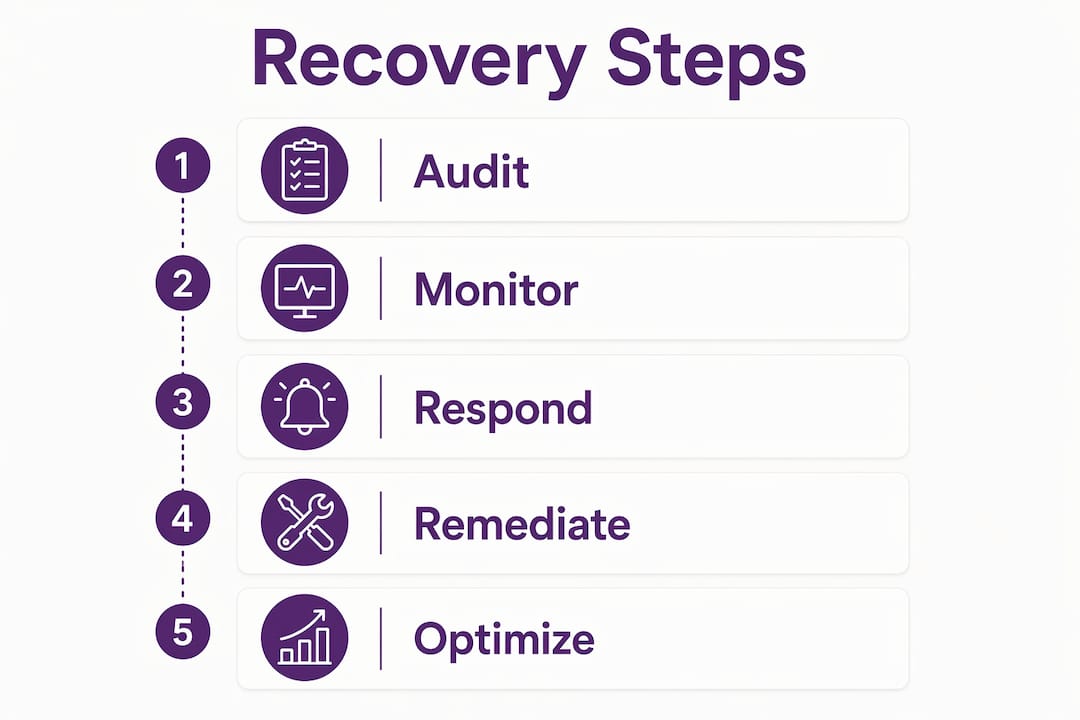
The first step before activating any pillar is a reputational audit. You need to know exactly what is damaged, where it lives online, and what caused it. A restaurant that receives a wave of one-star reviews because of slow service needs an operational fix, not just a PR response. Addressing root causes is what separates durable recovery from cosmetic repair.

AI-driven social listening tools are now essential in 2026 because manual monitoring cannot keep pace with the volume of mentions across Google, social platforms, and forums. Top brands use AI to shift from reactive damage control to preventative reputation management. For SMBs, even entry-level AI monitoring tools flag sentiment changes before they escalate into a crisis.
⚡ Pro Tip
Integrate your reputation audit findings directly into your operations review. If three separate reviews mention the same staff member or the same process, that is an operational problem, not a communications problem.
| Component | Role in recovery |
|---|---|
| Monitoring | Tracks mentions, sentiment, and review volume across all platforms in real time |
| Visibility control | Pushes authoritative positive content up in search results to displace negative listings |
| Response and remediation | Addresses negative reviews and complaints with professional, timely replies |
| Trust building | Generates authentic reviews, case studies, and community engagement to rebuild credibility |
How does a business respond effectively to negative reviews during recovery?
Responding within 24–72 hours of a negative review significantly improves recovery outcomes. Speed signals accountability. A response posted three weeks later reads as an afterthought, not a genuine effort to resolve the issue.
The structure of the response matters as much as the timing. Keep it brief, respectful, and free of defensiveness. A genuine apology requires three parts: recognition of the problem, accountability for it, and a concrete plan to prevent recurrence. Defensive apologies — ones that explain why the customer was wrong — damage trust more than silence does.
Negative reviews, when handled well, become public proof of your service quality. Every potential customer reading that thread sees how you behave under pressure. A calm, professional reply to a harsh review often impresses readers more than the complaint itself discourages them.
⚡ Pro Tip
After posting a public reply, invite the reviewer to continue the conversation by phone or email. Moving resolution offline de-escalates tension and prevents a public back-and-forth that can make the situation worse.
Best practices for responding to negative reviews:
- Acknowledge the specific complaint, not a generic version of it
- Use the customer's name if it appears in the review
- Avoid legal language or corporate disclaimers in the reply
- Offer a direct contact method for resolution
- Follow up internally to confirm the issue was actually fixed
- Respond to every Google review, positive and negative, to show consistent engagement
What long-term content strategies suppress negative search results?
SEO-driven positive content creation is the most reliable long-term method to push negative content down in search results. It requires regular publishing, optimized content, and link-building to prove relevance and authority to search engines over several months. There are no shortcuts that hold.
Suppressing negative search results takes an average of 10 months of continuous effort. That timeline surprises most SMB owners who expect faster results. The reason it takes that long is that search engines rank content based on accumulated signals, including age, backlinks, and engagement — none of which can be faked sustainably.
The content types that work best are those that earn genuine traffic and links. Blog posts answering common customer questions, updated Google Business Profile posts, press mentions, and original articles on industry topics all contribute. Each piece of content is a new asset competing for page-one real estate against the negative result you want to displace.
Fake reviews and black-hat SEO tactics carry severe consequences. Platforms remove entire review profiles when they detect manipulation. The Federal Trade Commission enforces disclosure rules around paid endorsements. A shortcut that triggers a penalty sets recovery back further than the original damage did.
| Approach | Method | Risk level |
|---|---|---|
| Legitimate: blog content | Publish optimized posts answering customer questions | Low |
| Legitimate: profile updates | Regularly update Google Business Profile with posts and photos | Low |
| Legitimate: link-building | Earn mentions from local press and industry directories | Low |
| Risky: fake reviews | Pay for or fabricate positive reviews | High — platform removal |
| Risky: black-hat SEO | Use link farms or keyword stuffing to force rankings | High — Google penalty |
⚡ Pro Tip
Build a content calendar with at least two published pieces per month. Consistency matters more than volume. Search engines reward sites that publish regularly over sites that publish in bursts.
How do you maintain trust and prevent reputation setbacks after recovery?
Online reputation management must be a continuous operational discipline, not a short project. Businesses that treat recovery as a campaign with an end date typically see their reputation erode again within a year. The compounding benefit of ongoing effort is what makes the difference between a business that recovered and one that stays recovered.
Governance changes are the most underrated part of post-recovery maintenance. If the root cause of your reputation damage was a broken refund process or undertrained staff, fixing the process is the only way to stop the same complaints from reappearing. Reputation systems cannot compensate for operational failures indefinitely.
Closed-loop follow-up is a concrete practice that builds durable trust. When a customer raises an issue, you resolve it, confirm the resolution with the customer, and log the fix internally. That loop prevents the same problem from generating a second complaint from a different customer six months later.
Generating authentic positive reviews is the most effective ongoing trust signal. Sending review requests at the moment of peak satisfaction — immediately after a successful service delivery — significantly increases the rate of positive responses. A direct link to your Google review form removes friction and makes it easy for happy customers to act.
Ongoing trust maintenance practices include:
- Set a weekly monitoring cadence to review new mentions and sentiment shifts
- Train customer-facing staff on complaint handling and escalation protocols
- Conduct a quarterly review of your top five review platforms for accuracy and completeness
- Use a customer feedback mechanism, such as a post-service survey, to catch dissatisfaction before it becomes a public review
- Track KPIs including page-one share of voice, average star rating, and review velocity month over month
What I've learned about reputation recovery that most guides won't tell you
Most SMB owners I work with come to reputation recovery expecting a campaign. They want a defined start date, a defined end date, and a clear deliverable. That framing is the single biggest reason recovery efforts fail.
Reputation is not a project. It is a reflection of how your business actually operates, communicated publicly at scale. When I see a business with a cluster of negative reviews around the same theme, I know immediately that the problem is not the reviews. The problem is the operation those reviews are describing. No amount of content creation or review generation fixes a broken customer experience.
The businesses that recover durably are the ones that treat the reputational audit as an operational audit. They use the findings to change processes, retrain staff, and fix the root cause. Then the reputation work — the content, the responses, the review generation — amplifies a genuinely improved business rather than papering over a broken one.
The other thing most guides understate is how long this takes. Ten months to suppress a negative search result is not a worst-case scenario. It is the average. Business owners who understand that timeline from the start make better decisions. They invest in sustainable content and ethical review generation instead of chasing shortcuts that create new problems.
If you are reading this after a reputation setback, the most useful thing you can do today is not to respond to every review or publish a press release. It is to sit down and honestly identify what caused the damage. That answer determines everything else.
— Vignesh
How Epicware helps SMBs with reputation recovery and local SEO
Reputation recovery requires consistent effort across monitoring, content, and review management. Epicware brings all three into a single dashboard built specifically for small and medium-sized businesses.
Epicware's platform tracks Google Maps rankings, monitors review sentiment, and surfaces the data you need to act before problems escalate. For businesses dealing with fake or unfair reviews, Epicware offers a bad review removal service where the $200 per-review fee is refunded in full if the review isn't taken down within 3 months. That refund guarantee removes the financial risk of trying to clean up your profile. With over 50 outlets managed and a track record of measurable results, Epicware gives SMBs the tools to recover faster and maintain the reputation they rebuild.
FAQ
What is a reputation recovery strategy?
A reputation recovery strategy is a structured plan to repair a business's public image after damage, using monitoring, professional responses, content creation, and trust-building practices. It is the applied, urgent form of online reputation management.
How long does reputation recovery take?
Suppressing negative search results takes an average of 10 months of consistent effort. Review sentiment and star ratings can improve faster with prompt responses and authentic review generation.
What are the first steps in a business reputation recovery plan?
Start with a reputational audit to identify what is damaged and why. Then address the root operational cause before launching any content or review response efforts.
How do you respond to negative reviews during recovery?
Respond within 24–72 hours with a brief, respectful reply that acknowledges the specific complaint, takes accountability, and offers to resolve the issue offline. Avoid defensive language.
Can fake reviews help speed up reputation recovery?
Fake reviews carry a high risk of platform removal and FTC enforcement action. They set recovery back further than the original damage. Authentic review generation at the moment of peak customer satisfaction is the only reliable method.
Key takeaways
A reputation recovery strategy succeeds only when it addresses root operational causes, not just public-facing content, and is maintained as an ongoing discipline rather than a one-time campaign.
| Point | Details |
|---|---|
| Four-pillar framework | Monitoring, visibility control, response and remediation, and trust building form the core of any recovery plan. |
| Root cause first | Fix the operational problem driving negative reviews before investing in content or review generation. |
| Response timing matters | Replying within 24–72 hours with a calm, accountable response improves outcomes and builds public trust. |
| Content takes time | Suppressing negative search results averages 10 months of consistent, ethical content and SEO work. |
| Recovery never ends | Treating reputation management as a continuous discipline, not a campaign, produces durable results. |
See where your Google Business Profile stands today — ratings, visibility gaps, and what's holding your reputation back — with a free audit from Epicware.
Get Your Free GBP Audit →