
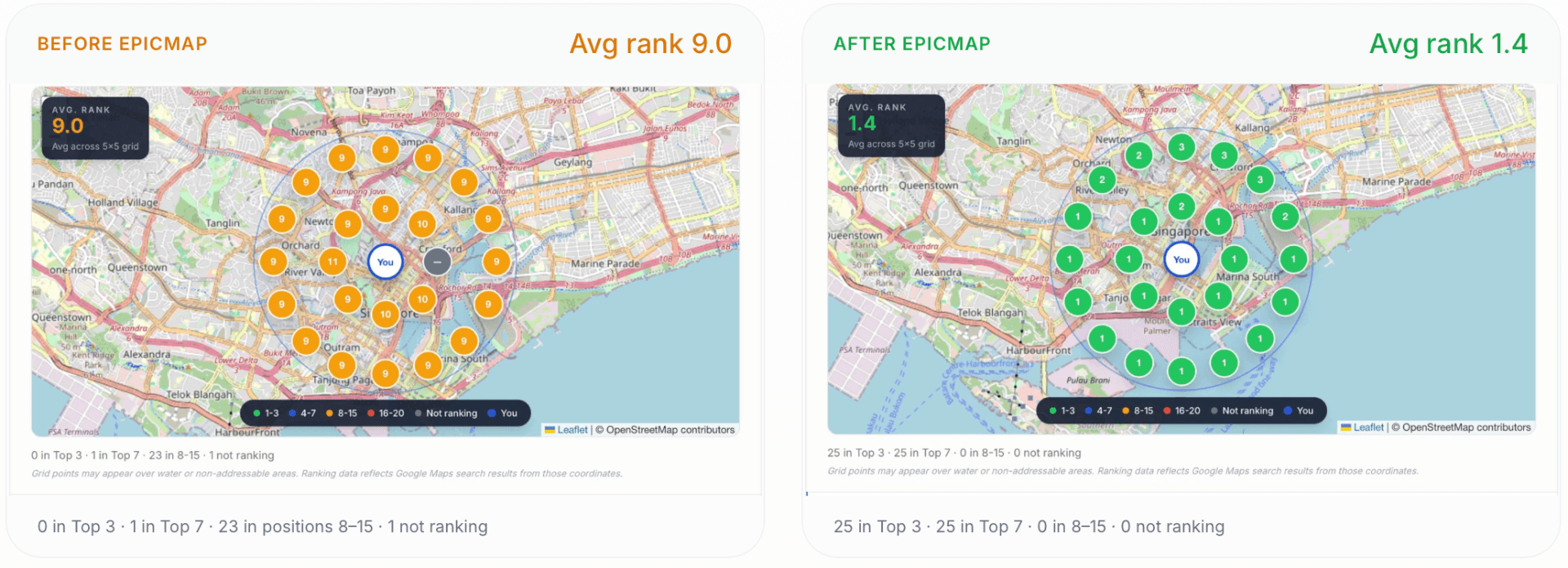
The local search landscape has shifted materially since 2024. AI-powered search features — Google AI Overviews, ChatGPT search, Perplexity — have added a new layer to how potential customers find local businesses. Traditional Google Maps optimisation remains the foundation, but it is no longer the complete picture.
This playbook covers what actually works for Singapore SMBs in 2026: from the fundamentals of GBP optimisation to the emerging requirements of AI search visibility.
What Changed in 2025–2026
Several developments have reshaped local search for Singapore businesses:
- AI Overviews in Google Search: For many informational local queries, Google now surfaces an AI-generated answer above organic results. For businesses, this means the featured snippet position is now harder to achieve but more visible when earned.
- ChatGPT and Perplexity as search tools: A growing share of Singaporeans use AI chatbots to find local recommendations. "Best GP clinic in Tampines" typed into ChatGPT returns business recommendations drawn from indexed web content and reviews.
- GBP becoming more prominent: Google has continued expanding what information is surfaced from GBP profiles — menus, services, photos, and posts are all now more visible in Maps results.
The Local Search Funnel in 2026
A Singapore consumer looking for a local business in 2026 might follow several paths:
- Direct Google Maps search — still the dominant path for most categories
- Google Search with AI Overviews for informational queries
- AI chatbot recommendation (ChatGPT, Perplexity, Gemini)
- Social discovery (Instagram, TikTok) — particularly for F&B and beauty
Optimising for path 1 (GBP and Maps) covers the majority of local search traffic. Paths 2–4 require additional content and presence strategies, but return on investment is lower for most SMB categories.
GBP as Foundation
In 2026, the Google Business Profile remains the single highest-leverage asset for most Singapore SMBs. A well-optimised GBP profile with strong review velocity and a complete service/category structure provides visibility across all Google surfaces — Maps, Search, AI Overviews, and the knowledge panel.
The 19-point GBP audit covers: correct primary and secondary categories, complete service listings with descriptions, accurate hours including public holidays, a minimum 15-photo library, weekly GBP posts, populated Q&A section, and a linked website with consistent NAP (Name, Address, Phone) data.
Review Strategy
Reviews in 2026 serve two purposes: ranking signals for Google Maps, and source material for AI-generated recommendations. When an AI chatbot recommends a local business, it draws from aggregated review sentiment and the content of reviews themselves.
The review strategy for 2026 is identical to prior years at its core — ask every customer, ask via WhatsApp, ask at the right moment, respond to every review — but the urgency is higher. AI systems that recommend businesses draw from larger review datasets. A business with 200 reviews provides more signal than one with 20.
AI Overview Optimisation
For businesses in categories where Google AI Overviews appear for local queries (often healthcare, legal, financial services), appearing in the Overview requires your business to be cited in authoritative web content. This means: accurate and complete GBP, consistent listings in authoritative directories (HealthHub for clinics, Lawyers.sg for legal), and informative content on your website that answers common queries.
For most SMB categories in Singapore, optimising specifically for AI Overviews returns less than optimising GBP and Maps rank. The exceptions are professional services and healthcare, where patients often ask informational questions that trigger AI answers before clicking to Maps.
Multi-Location Management
For businesses operating multiple outlets, the complexity of local search management scales with each location. Each outlet needs its own GBP, its own review velocity, and its own rank tracking. The operational solution is a multi-outlet dashboard that centralises management across all locations without requiring individual attention to each profile.
Platform vs Agency Decision
Singapore SMBs choosing between a self-serve platform and a full-service agency should consider: volume of locations, internal capacity for ongoing management, and urgency of results. Platforms like Epicware provide the tools and automation; managed services provide the execution. Most businesses with 1–3 locations can achieve strong results using a platform approach. Groups with 5+ locations typically benefit from managed execution.