
Review recency is the number one individual local ranking factor in 2026. Reviews under 30 days old carry full algorithmic weight, while reviews older than 180 days retain only 10–20% of their original influence. For business owners, this means your review strategy cannot be a one-time campaign — it must be a continuous operational process tied directly to your Google Business Profile performance.

Why does review recency matter for local search rankings?
Review recency — also called review freshness — is the measure of how recently your business received new customer reviews. Google's local ranking algorithm treats it as a real-time signal of whether your business is actively serving customers right now. A business with 200 reviews from three years ago tells Google very little about its current state. A business with 15 reviews from the past 30 days tells Google everything.
The weight decay is steep and fast. Reviews lose ranking influence progressively between 30 and 180 days, dropping to just 10–20% influence after six months. That means a review posted in January is nearly worthless by July. Business owners who ran a review campaign once and stopped are essentially running on empty.
Three distinct concepts drive this section of local SEO — confusing them is a common mistake:
- Review recency: How recently your last review was posted.
- Review velocity: The rate at which new reviews arrive over time.
- Total review count: The cumulative number of reviews on your profile.
Review velocity is a stronger ranking signal than total count because it reflects real-time customer satisfaction rather than historical accumulation. A business receiving five reviews per month consistently outranks a competitor with 500 old reviews and no recent activity. Google reads velocity as proof that customers are walking through your door today.
How do recent reviews affect AI-powered search recommendations?

AI-driven search engines treat recent reviews as verifiable proof of current service quality. AI recommendation models weight reviews from the past 90 days 2–3 times more than reviews that are a year old. That multiplier effect means a business with consistent fresh reviews gets dramatically more AI-generated visibility than one with an older, larger review base.
A review from 14 months ago cannot confirm whether your restaurant still has the same chef, whether your clinic still has the same staff, or whether your service quality has held up. A review from last week can. AI models treat recency as a proxy for reliability.
The data confirms this at scale:
- 74% of consumers only pay attention to reviews from the past three months.
- 32% consider only reviews from the last two weeks.
- Reviews older than three months are perceived as 30–40% less credible, and conversion rates drop 8–15% when the latest review is over six months old.
That last figure connects review recency directly to revenue. Lower conversion rates mean fewer bookings, fewer walk-ins, and fewer sales — regardless of your star rating.
Steady, ongoing review acquisition outperforms short-term spikes for both SEO and AI visibility. Inconsistent review flows can actively harm rankings.
What are the practical steps to maintain review recency?
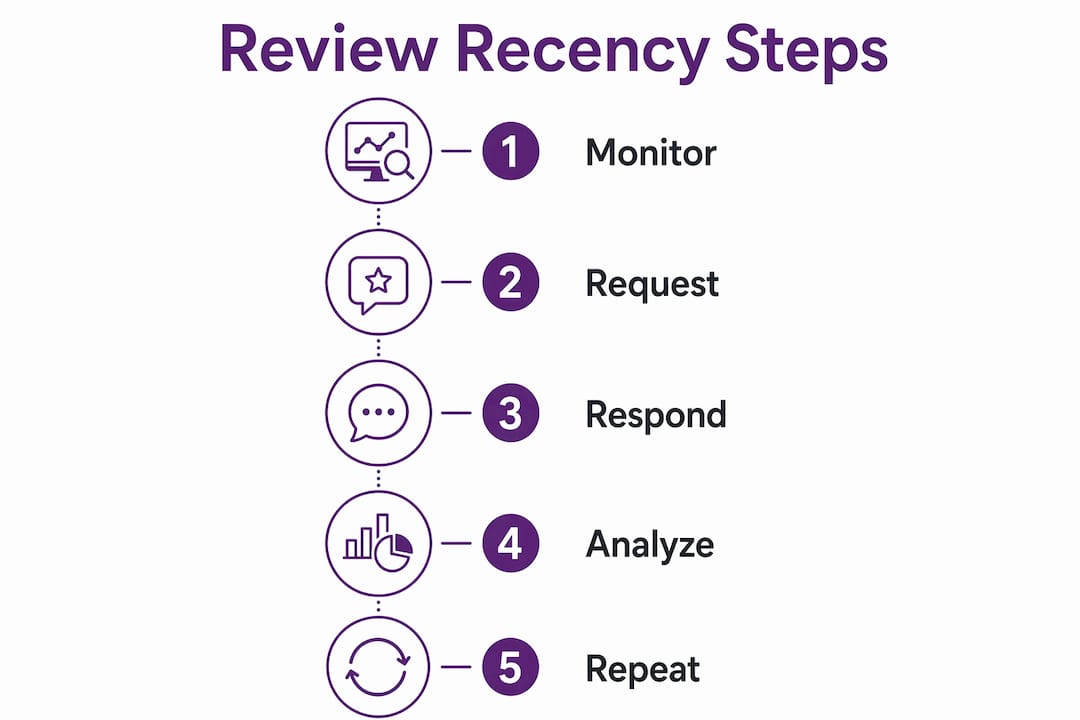
Maintaining review recency requires a system, not a campaign. One-time pushes generate spikes that decay fast. Inconsistent review flows can harm rankings because Google interprets the gap as a signal of reduced business activity. The goal is a steady, predictable cadence of new reviews every month.
- Set a monthly review target. For most SMBs, 4–8 new reviews per month is a strong baseline. Restaurants and clinics should aim for 10–15.
- Automate review requests. Send requests via SMS or email within 24–48 hours of a completed transaction. Customers are most likely to review when the experience is still fresh.
- Diversify your request channels. Use post-purchase emails, WhatsApp follow-ups, QR codes at your counter, and receipts. Different customers respond to different touchpoints.
- Highlight your newest reviews. Feature recent reviews on your website and social media. This signals to both Google and visitors that your business is active right now.
- Monitor velocity as a KPI. Track how many new reviews arrive each month, not just your total count. A drop in monthly velocity is an early warning sign before a ranking drop occurs.
Local pack suppression often begins within 60–90 days of review inactivity. Ranking recovery after fresh reviews return typically takes 2–4 weeks. A two-month review drought can cost you six weeks of lost visibility even after you fix it. Prevention is far cheaper than recovery.
How does recency interact with ratings, diversity, and response rate?
Review recency is an independent ranking signal. It does not cancel out a low star rating, but it also does not depend on a perfect one. A new 4-star review carries more ranking impact than an 18-month-old 5-star review because recency signals current active operation. Most business owners do not know this.
| Ranking signal | What it measures | Interaction with recency |
|---|---|---|
| Review recency | How recently reviews were posted | Primary freshness signal; decays rapidly after 180 days |
| Star rating | Average score across all reviews | Recency can outweigh rating when freshness gap is large |
| Review velocity | Rate of incoming reviews per month | Works alongside recency; steady velocity amplifies freshness |
| Review diversity | Mix of platforms, reviewer types, topics | Broadens trust signals; does not replace recency |
| Response rate | How often the business replies to reviews | Shows engagement; Google rewards active profile management |
A business with a 4.2-star average, consistent monthly reviews, and prompt responses will outrank a competitor with a 4.8-star average and a six-month review gap. Recency is the multiplier that makes all other signals matter more.
The operational mindset shift that most businesses miss
Most businesses treat reviews as a marketing metric. They run a campaign, collect a batch of reviews, and move on. That approach treats reviews like a one-time asset, when they are actually a perishable one.
Working with businesses across multiple categories, the pattern is consistent. A business collects 40 reviews in a month after a push campaign, ranks well for six weeks, then drifts back down as those reviews age out. The owner is confused because the total count did not change. The problem is that the freshness of the profile collapsed — Google stopped seeing evidence of current activity.
The businesses that hold their rankings month after month treat review collection the way they treat inventory management. It is a recurring operational task with a weekly check-in, not a quarterly campaign. They know their review velocity number the same way they know their weekly revenue. That level of attention separates businesses that rank consistently from those that spike and fade.

— Vignesh, Epicware
Frequently Asked Questions
What is review recency in local SEO?
Review recency refers to how recently a business received new customer reviews on platforms like Google. It is the number one individual local ranking factor in 2026, with reviews under 30 days old carrying full algorithmic weight.
How quickly do old reviews lose their ranking power?
Reviews lose influence progressively between 30 and 180 days, dropping to just 10–20% of their original weight after six months. A review posted six months ago contributes almost nothing to your current ranking.
Can a 4-star review outrank a 5-star review?
Yes. A recent 4-star review carries more ranking impact than an 18-month-old 5-star review because Google weights current operational signals over historical ratings.
How often should a business collect new reviews?
Most small and medium businesses should target 4–8 new reviews per month. High-traffic businesses like restaurants or clinics should aim for 10–15 per month to maintain strong review velocity.
What happens if a business stops getting reviews for two months?
Local pack suppression typically begins within 60–90 days of review inactivity. Ranking recovery after fresh reviews return usually takes 2–4 weeks, meaning a two-month gap can cost six weeks of total lost visibility.
EpicReview automates your review request workflow so fresh reviews arrive every month — without you having to think about it.
Never Let Your Reviews Go Stale →